


 English

|
Advertisement / Annons: |
Nebula |
| Object : | NGC 1499 |
| Coordinates/Direction : | RA: 04h03m, DEC: +36o25' |
| Object size : | 160' x 60' |
| Object magnitude : | 6 |
| More to know : |
Wikipedia: https://en.wikipedia.org/ wiki/ California Nebula |
NGC 1499, 2025-01-31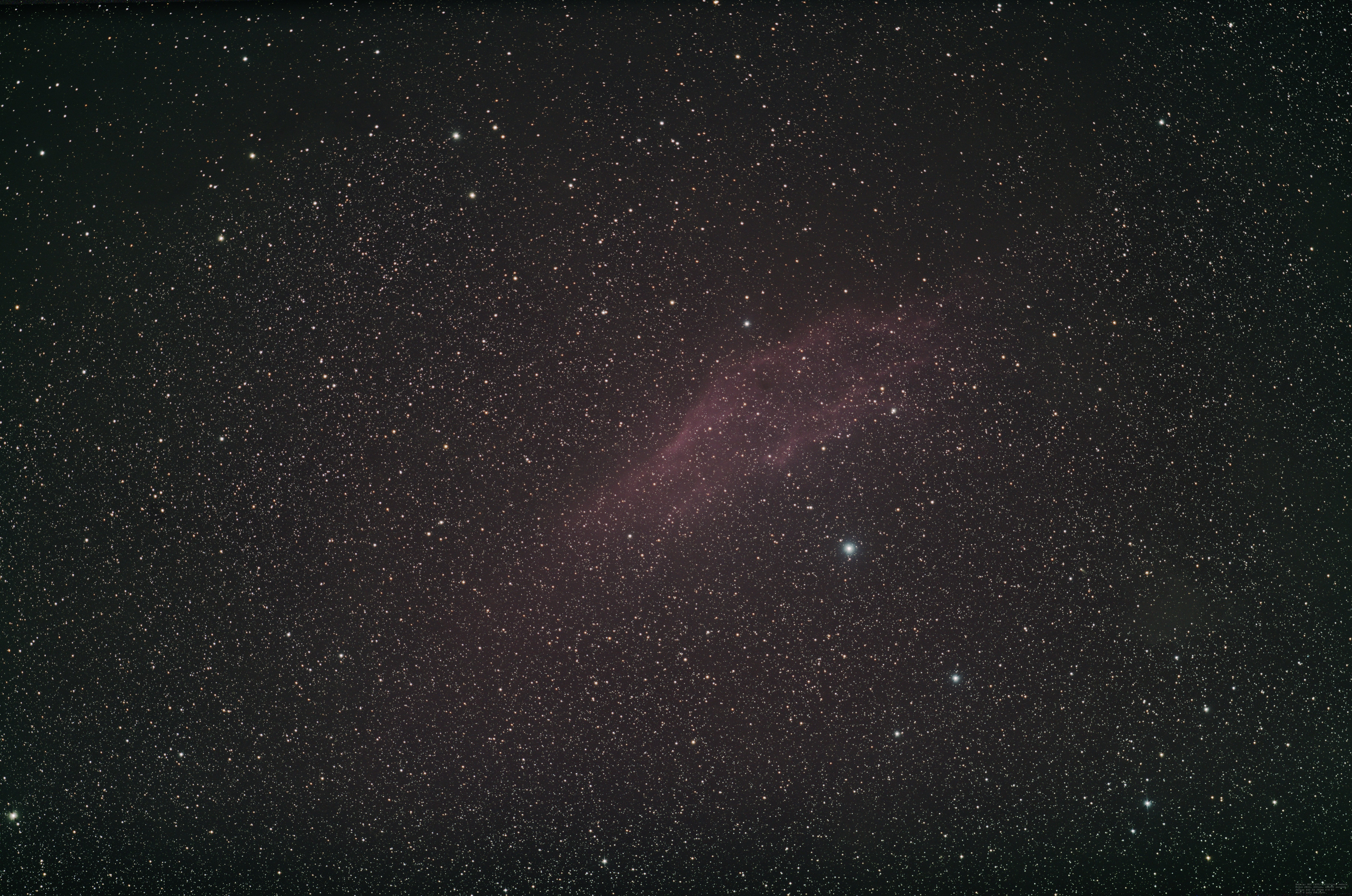 (Click on image and get one in full resolution in a new window)
|
| Date : | 2025-01-31 |
| Time (UT) : | - |
| Mount : | SkyWatcher EQ6 Pro, Belt drive, beltdrive modified (DIY 2019) |
| Guide : | ASI120 camera with off-axis |
| Lens/telescope : | Pentax 645 FA 300 mm ED f/4 (medium format lens) |
| Corrector/Barlow : | - |
| Field (FOV) : | 6.8x4.5o (full frame) before crop |
| camera : | Nikon D800, QE=0.56, full frame, 36 Mpixel, 14 bit |
| camera temperature: | - , no temperature sensor |
| Film/CCD : | Raw, NEF |
| Filter : | none |
| Control system: | Mount, camera, focus, guide (Ekos) controlled by KStars/Ekos Linux, 64-bit |
| Exp. time : | 48x240 seconds, 400iso, every 3rd dithered |
| Image process tool : | Siril, Gimp, Irfanview |
| Processing : | bias 150, flat and photometric color calibration |
| Weather : | clear, Moon Phase 5%, Temperature -1o C |
| Site : | Sweden, Stockholm, Tyresta Nature reservation, Spirudden. Bortle 4 |
| Comment : | My setup is almost perfect for the California nebula. This evening I went to a dark place with a friend to do some astrophotographing. At 9 pm the Moon goes below the horizon and the sky clear up. Got it better than earlier, a dark sky helps a lot when photographing nebulas. Later I will process the image further, there are alot more that could be done to it. |
NGC 1499, 2023-09-11 to 2023-10-16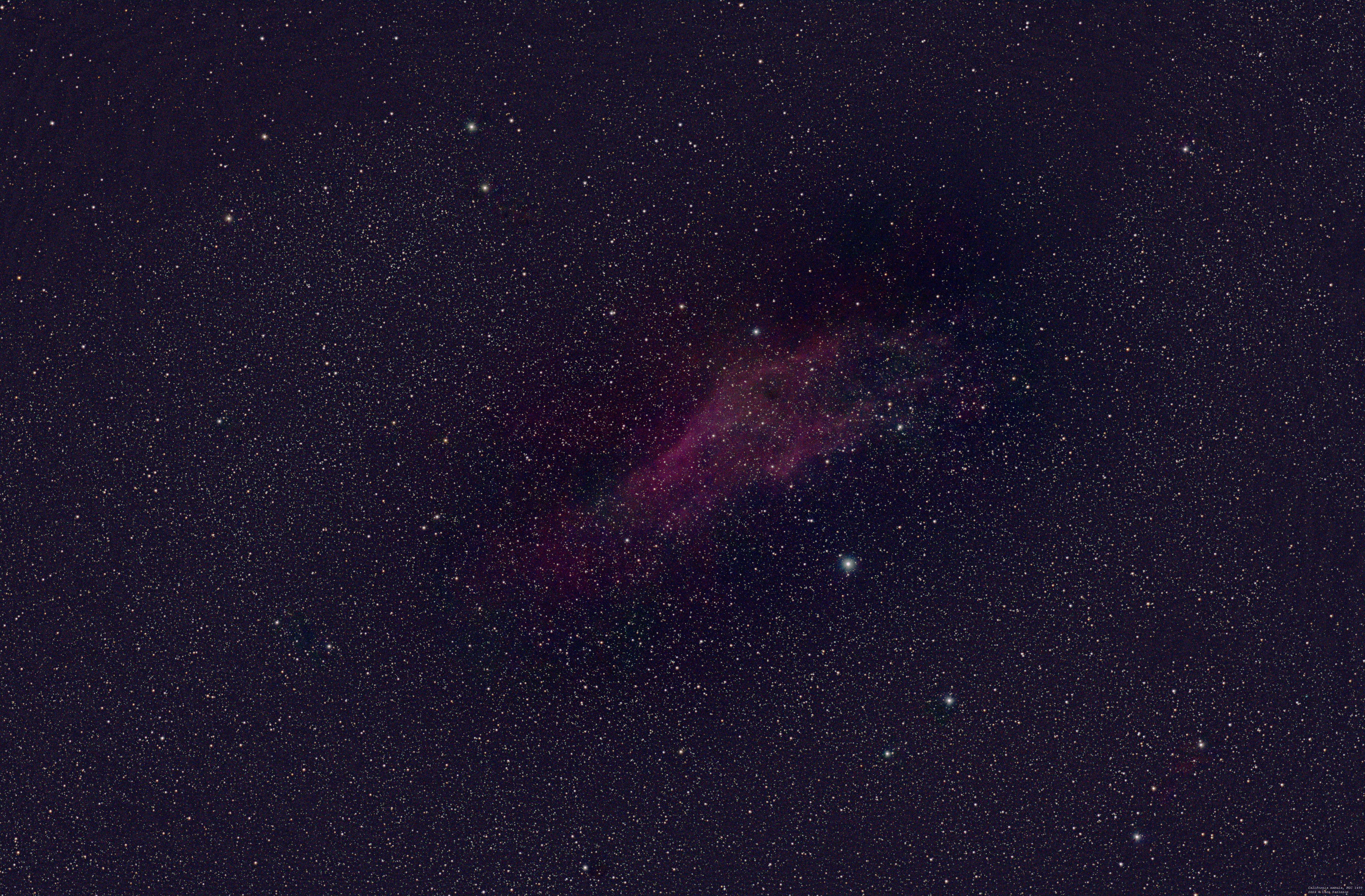 (Click on image and get one in full resolution in a new window)
|
| Date : | 2023-09-11 to 2023-10-16 |
| Time (UT) : | - |
| Mount : | SkyWatcher EQ6 Pro, Belt drive, beltdrive modified (DIY 2019) |
| Guide : | QHY5 camera with 200 mm f/3.5 lens |
| Lens/telescope : | Pentax 645 300 mm ED f/4 (medium format lens) |
| Corrector/Barlow : | - |
| Field (FOV) : | 6.8x4.5o (full frame) before crop |
| camera : | Canon 6D, QE=0.5, full frame, 20 Mpixel, 14 bit |
| camera temperature: | About 6o C above surrounding temperature |
| Film/CCD : | Raw, Cr2 |
| Filter : | none |
| Control system: | Mount, camera, focus, guide (Ekos) controlled by Astroberry (KStars/Ekos Linux) |
| Exp. time : | 256x60 seconds, iso1600, dithering mode |
| Image process tool : | Siril, Gimp, Irfanview |
| Processing : | cal bias, flat and astro metric color calibration |
| Weather : | clear |
| Site : | Sweden, Stockholm, Hagsätra.
Bortle 9 Free view Az: 20o to 90o, 165o to 185o, Alt: 20o to 55o |
| Comment : | Added one more hour of exposure to the previous ones, more than 4 hours now. |
NGC 1499, 2023-09-11 to 2023-10-12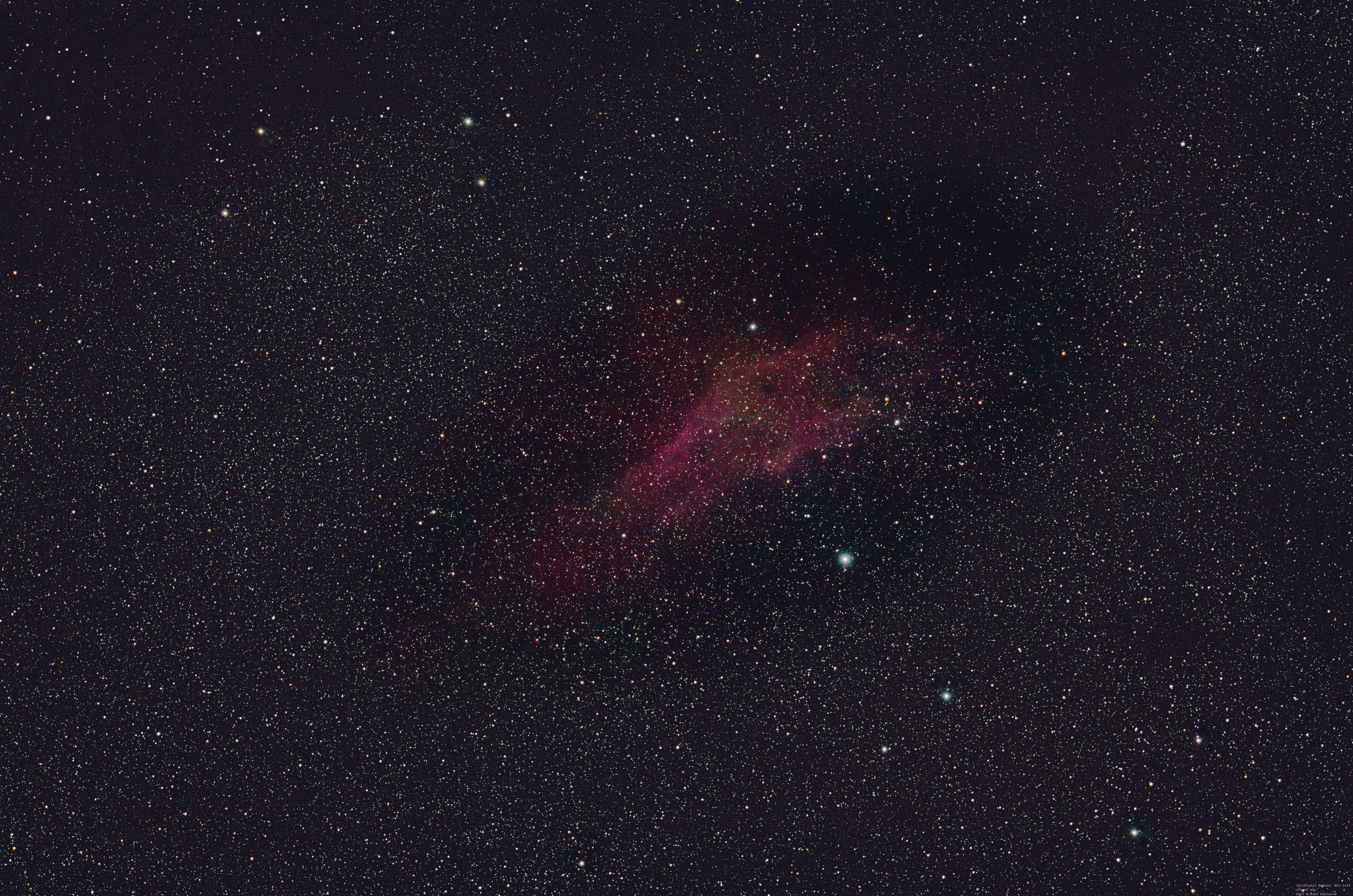 (Click on image and get one in full resolution in a new window)
|
| Date : | 2023-09-11 to 2023-10-12 |
| Time (UT) : | - |
| Mount : | SkyWatcher EQ6 Pro, Belt drive, beltdrive modified (DIY 2019) |
| Guide : | QHY5 camera with 200 mm f/3.5 lens |
| Lens/telescope : | Pentax 645 300 mm ED f/4 (medium format lens) |
| Corrector/Barlow : | - |
| Field (FOV) : | 6.8x4.5o (full frame) before crop |
| camera : | Canon 6D, QE=0.5, full frame, 20 Mpixel, 14 bit |
| camera temperature: | About 6o C above surrounding temperature |
| Film/CCD : | Raw, Cr2 |
| Filter : | none |
| Control system: | Mount, camera, focus, guide (Ekos) controlled by Astroberry (KStars/Ekos Linux) |
| Exp. time : | 196x60 seconds, iso1600, dithering mode |
| Image process tool : | Siril, Gimp, Irfanview |
| Processing : | cal bias, flat and astro metric color calibration |
| Weather : | clear |
| Site : | Sweden, Stockholm, Hagsätra.
Bortle 9 Free view Az: 20o to 90o, 165o to 185o, Alt: 20o to 55o |
| Comment : | After collecting all photos I have of the California Nebula it summed up to 3 hour and 16 minutes exposure. That will reduce the noise and make it easier to get out the nebula from the light pollution. Much better result now. If I take new photos from a dark place it should even better. The red radiation is the H-Alpha, it has the wavelength 656 nm, the is on the edge of the visual range. A camera that has its IR cut filter removed will get its sensitivity for this wavelength increased by at least two times. Should I do this IR modification on my old camera or buy a new real astrocamera ? The first is free if I do it by myself, the other cost a lot. |
NGC 1499, 2023-10-07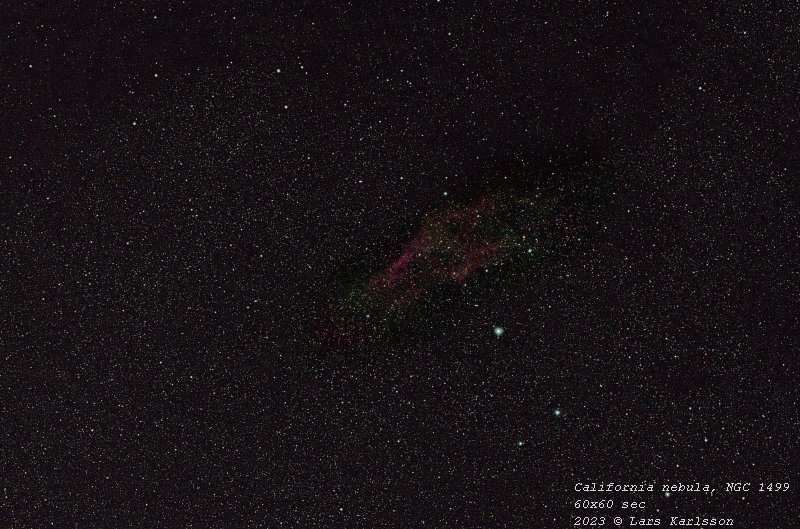
|
| Date : | 2023-10-07 |
| Time (UT) : | 20:22 to 21:37 |
| Mount : | SkyWatcher EQ6 Pro, Belt drive, beltdrive modified (DIY 2019) |
| Guide : | QHY5 camera with 200 mm f/3.5 lens |
| Lens/telescope : | Pentax 645 300 mm ED f/4 (medium format lens) |
| Corrector/Barlow : | - |
| Field (FOV) : | 6.8x4.5o (full frame) before crop |
| camera : | Canon 6D, QE=0.5, full frame, 20 Mpixel, 14 bit |
| camera temperature: | About 6o C above surrounding temperature |
| Film/CCD : | Raw, Cr2 |
| Filter : | none |
| Control system: | Mount, camera, focus, guide (Ekos) controlled by Astroberry (KStars/Ekos Linux) |
| Exp. time : | 60x60 seconds, iso1600, dithering mode |
| Image process tool : | Siril, Gimp, Irfanview |
| Processing : | cal bias, flat and astro metric color calibration |
| Weather : | clear |
| Site : | Sweden, Stockholm, Hagsätra.
Bortle 9 Free view Az: 20o to 90o, 165o to 185o, Alt: 20o to 55o |
| Comment : | The California nebula is really big, its length is 2.5 degree, 5 times the Moon. It's relatively bright too, magnitude 6. I tested with a photo from the balcony if there is possible to see anything of it. And yes it is, but need a lot longer exposure time than the one hour I took and I must be at a dark place too. Processing these kind of objects is more tricky than normal star images, you must get rid of the background without erasing the nebula at the same time. Something that I need to practize on. |
Crop IC 417 2023-10-07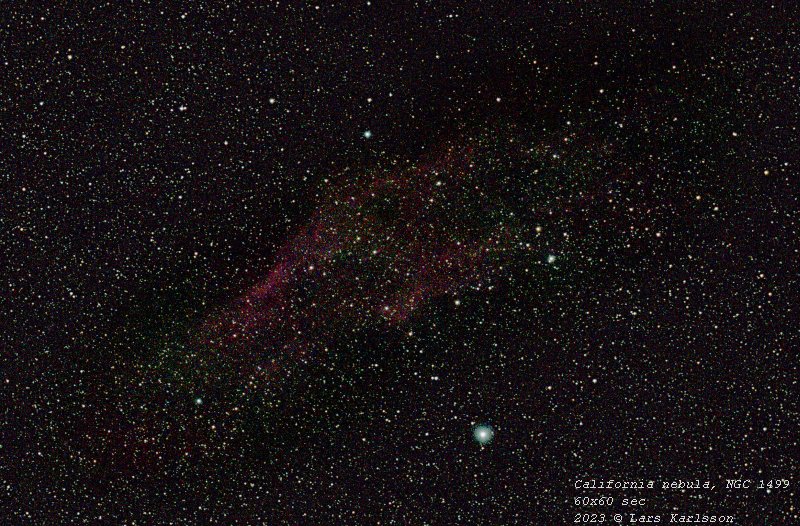
|
| Date : | 2023-10-07 |
| Time (UT) : | 20:22 to 21:37 |
| Comment : | A crop around the nebula to see it more clearly. The nebula is inside our Milky Way galaxy at a distance of 1000 ly. It was discovered relatively late, 1884 by E. E. Barnard. It emits its radiation at 656 nm and 486 nm. Very difficult to observe visually, better with cameras and narrow band filter centered around these wave lengths. |
|
| Go Back |